Wednesday, February 15, 2012

Technology

While hiking in the forest today, I came upon a friendly dog wearing a bulging collar. Soon, the dog's owner appeared on the trail. I asked him about the collar, and he told me that the collar had a radio transmitter that beamed a signal to his GPS. On the GPS, I could clearly see the trail we were on, and he could see where his dog was. He said he could also get in touch with his dog, and he pulled out another device. With this tool he could "beep" the dog so the dog would know he was being called or he could actually give the hapless dog a shock as some sort of punishment for perhaps straying too far. But he would never do that, he told me. Clearly he loved his dog.
I also noticed he was carrying his iPad on the forest trail, and I asked him why. He said the iPad was like taking his office with him. In the tablet he had a list of all his products and prices along with sales records. If he had to carry the physical documents, they would have been the size of the New York City telephone book. But here, they were neatly stored in his iPad, and if necessary, he could do his business right from the trail. He really had no need to sit in the office.
What does this have to do with bread baking? I don't know.

Tuesday, February 14, 2012

Artisan Bread In Five Minutes A Day (con't)

On Tuesday morning I took the highly aerated dough from the cold storage room where it had been kept since Sunday at around 45-50º. I scooped out a hunk and placed it in my banneton. Probably I should have scooped out more because the dough was really undersized for the banneton, and it barely rose at all. The instructions tell you to bake after about 40 minutes, but I wasn't excited about putting such a cold dough in my conventional gas oven. I waited about two hours, and the dough was still cold. I baked it anyway and did get a little oven spring.
The crust is thin and crisp, just the way I like it, and the dough is pleasantly filled with mouse holes, but the flavor did not excite me. In fact, there really wasn't much flavor, and it tasted slightly salty.
I will, however, continue with this method for awhile to see where it takes me.

Monday, February 13, 2012

Artisan Bread In Five Minutes A Day

Artisan Bread In Five Minutes A Day is the name of the book by Jeff Hertzberg and Zoë François.
First off, I was totally turned off by the title. Why is it that everything has to get done in five minutes?
And that would include eating, sex, meditation and of course, bread baking.
Once I got past the title, I read an article in Mother Earth News that explained the technique. Okay, I was intrigued, so I mixed up the dough yesterday, and now it's in the refrigerator. I hope to bake with it on Tuesday or Wednesday, and I'll post the results. The recipe calls for a lot of instant yeast (really a lot), and let's think it's not the same as "doping" to help you to create stellar loaves.
Eric from Gardenfork. TV does an interesting comparison between the "no knead" and the "five minute a day" technique. Watch the video here.

Tuesday, February 7, 2012

Bread Undercover

If you're baking indoors in a conventional oven, be it gas or electric, there's only one way I know of to make great bread. To make the best breads, you have to bake undercover, and that means baking in some sort of cloche.
 What to expect

The cloche might be a cast iron Dutch oven, La Cloche, an inverted flowerpot or some other variation. Baking undercover attempts to replicate the conditions of a genuine wood-fired bakeoven by trapping the steam escaping from the baking loaf. To make a fine crust you need steam. If you don't bake undercover, the steam simply dissipates too quickly from a conventional oven to do any good. Your baking loaf needs to be surrounded by a cloud of hot steam that will postpone the formation of tough crust. The most popular device on the market that allows you to trap the steam is La Cloche, but the price is around $54.00. I've had a couple of them, and they do a fine job, but the bottoms tend to break from hot ovens. If it only happened to me, then I'd be suspect of my procedures, but I know it's happened to others as well.


You could easily make your own oven insert out of a clay pot, and it will work just as well. Your cost would be under $15.00.


A Dutch oven also does a superb job, and I bought a beautiful one from Lodge.


Most "experts" who bake undercover say you must remove your cover anywhere from 15 to 30 minutes into the bake. Then you're instructed to finish the bake without a cover. Yes, this certainly works, but if your goal (as is mine) is to strive for a thin, crisp crust, then leave the cover in place for the full bake, but reduce the temperature for the last 15 minutes. I bake on a shelf half way up the oven, but on the lowest shelf I place an insulated cookie sheet to help deflect heat away from the bottom of the baking bread. This will keep the crust from burning.


Saturday, February 4, 2012

Achieving A Failure

Achieving A Failure
And that's a good thing because it means I'm working and experimenting. What's the sense of finding some comfortable niche that only limits my growth as a bread baker or artist. To always succeed at something bespeaks a timid attitude. Yes, I can always bake the same loaf of bread using the same procedures, and that's what professional bakers need to do if they're selling to the public. Or, I can keep painting the same scene with slight variations, never taking any real chances, because then I might be afraid no one would want to buy my work, but what kind of a life is this?


When Dylan wrote, "there's no success like failure," he wasn't joking. And when Emerson said "A foolish consistency is the hobgoblin of little minds," it doesn't take a quantum leap to draw a parallel with what Dylan said.
Yes, it's much more difficult for me to make a piece of art using unfamiliar colors and materials or construct an earth oven of unusual design. Sure, I might fail, but I'd prefer that to riding on a wave of certitude that will always inhibit my growth.


Today I am changing my sourdough bread formula. Day#1  Normally I use about 1/4 cup of sourdough starter for a loaf of bread. Today I stirred in a full cup of starter. I don't really know (although I think I do) what will happen, but I'll let you know the results. Day#2. The resulting bread was heavy, although filled with mouse holes, between them it was dense and very sour, not exactly my favorite.


Yes, I used too much sourdough starter, but I had to go to that place. I went there because I was asking my perennial question. What if?

P.S. I forgot to mention in my last post that I never did get an opportunity to achieve another failure in Guatemala making corn tortillas. I was simply too busy building stoves, and I didn't have time to mess with the masa harina. Just as well.
Stu

Tuesday, January 31, 2012

Back from Guatemala

I'm back home now from Guatemala, and as always, my stomach needs a little bit of repair. Unfortunately it's not so easy to stay well there, and there's not too much you can do about it. One does have to eat, drink and touch things.
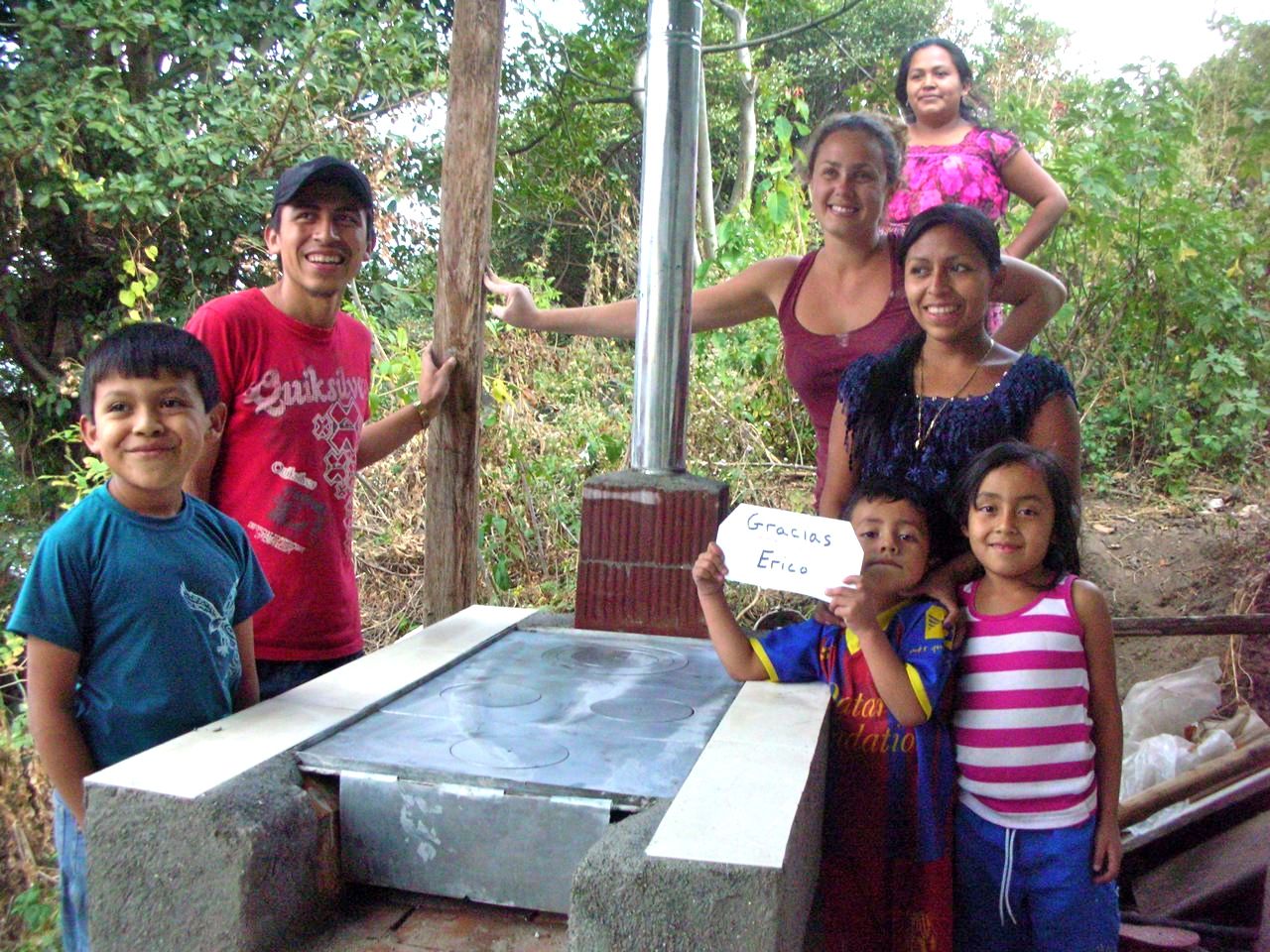
Anyway, lots of energy efficient stoves were built by our group, and you can see some smiling faces by one of the stoves. My son Eric financed the cost of materials for the stove in the photo.
The stoves we build are intended to replace the "three stone fires" where Mayas develop all kinds of respiratory problem from constantly breathing smoke.

Energy efficient stove for making flat breads (tortillas), soups and for general cooking purposes.

Maya shrouded in a miasma of unhealthy smoke from cooking over a "three stone fire."


Wednesday, January 18, 2012

Back to Guatemala

In another couple of days I'll be heading back to Guatemala. I think it's my seventh trip, and I'm as excited as usual. My first two trips were to construct ovens for Safe Passage by the Guatemala City dump. The dump experience is one I'll never forget. You can see the ovens being constructed on YouTube.
More recently, I've been going to Guatemala with a group called Masons On A Mission and we build energy efficient stoves for the Mayas in the villages around Lake Atitlan.

Besides building stoves, I've been trying to learn how to make corn tortillas, and I'm probably the only male who has attempted this is Guatemala. It's definitely not something that men do, but the women are quite accommodating in letting me participate. As hard as I try to make a tortilla that the Mayas approve of, I'm quite confident I'll achieve another failure.

Tuesday, January 17, 2012

Bread Baking and Oven Building Class

This spring I'll be teaching a bread baking and oven building class. Although the class is currently filled, there is a waiting list, and I might consider adding another class.

Do you enjoy really great bread, but don't know how to make it, or if you do, it causes a lot of anxiety? If yes, then join me and all your bread baking hassles will be over. We will be baking in my wood-fired oven outdoors, but we will also be baking in my conventional gas range in the kitchen. Outdoors we'll make all types of flat breads which may include pitas, journey cakes, zatar, bagels, bialys, onion breads superieur and brick oven pizza. Indoors our focus will be sourdough and yeasted loaves, utilizing my no-knead technique. Expect to bake undercover with cloches to achieve that perfect crust.


A complimentary sourdough starter will be available for all. The primary focus of this class is hands-on bread baking, but while the bread is in the oven, we'll watch some bread baking videos, and also for those who are interested, we can assemble a small brick oven outdoors, a perfect low-cost oven that you can build at home for your pizza parties!


Lunch included. A materials fee of $20 must be made payable to Stu Silverstein and submitted to the adult ed office at the time of registration. Your place will not be held until the materials fee is received.

$29.00
Online price
Available slots:  0

Course location Course location

Location address not available.
Please contact us for the exact location of where this course will be held.

Phone: 873-5754-Waterville/Winslow ~ 465-9134-Messalonskee

Course schedule Course schedule

This course meets Sat from 9:00 am to 2:00 pm for 1 week.
Start date: June 2nd, 2012
End date: June 2nd, 2012

Course details Course details

Instructor: SILVERSTEIN, STU
Course ID: 2009248.312

Monday, January 16, 2012

GardenFork.TV

Check out this website for lots of useful information about baking, gardening, home repairs and just about anything else that you might find useful or not.There is even a video of the construction of a portable brick pizza oven based on a design from Bread Earth and Fire.
Instead of having to buy angle iron (expensive), Eric came up with the ingenious idea of cutting up an old iron bed frame that was made from angle iron. Hey, recycle and reuse when you can.

Insulated oven base just waiting for pizza oven
 
Fire almost reaching the plasma (love that word) stage. Note the firewood drying on top. The top is also a neat place for keeping baked pizzas hot. Watch the video to see how easy it is to construct the oven. No mortar required!


Thursday, January 12, 2012

Keeping Bread


Bread does not keep particularly well. In fact, it's best to eat the bread the day you bake it, but only after it's cooled. Allowing the bread to cool before slicing it, is important. It's not that we want to do a Sylvester Graham number and postpone gratification, but rather we want the bread to finish baking. Yes, it's still baking while it's cooling on the rack. I know this is an oxymoron, but it's a real phenomenon.
If you can't eat the bread on day number one, then it's okay to place it face down (the side you've cut) on your cutting board. It should still be edible on day number two. Remember, toasting does have a wonderful rehabilitative effect, but don't even think about nuking it in the microwave. 
Unless you have high humidity in your kitchen, after the second day the bread may become dry and hard. 
I have gone back and forth on plastic bags, but they certainly will keep the bread soft. But soft bread doesn't mean "fresh bread." Freshness may only be a illusion because bread will soon begin to compost if it's left in plastic for too long. You may choose to be a purist and not use plastic, but I have seen people break a tooth from chomping down on crusty bread. There are plastic bread bags with tiny perforations that do allow a breath of fresh air, and you could try these.
Or, you might want to try a breadbox for keeping bread. See the above photo. 
But no matter what you contrive, the day of reckoning will soon be upon you. Either eat the bread, make Tuscan bread soup, bread crumbs, bread pudding or give it to the birds.


By baking frequently, you should always have fresh bread at home, and bake extra if you can for your friends and homeless shelters.