Saturday, November 2, 2013

San Francisco

I've just returned from a trip to San Francisco, and I ate some really terrific bread. When folks think of bread in San Francisco, they generally think of sourdough, and probably they should. There actually is a sourdough which is truly sour and it is made by the Boudin Bakery.
This is the distinctive San Francisco sourdough, and I've never found the same flavor anywhere else.
My favorite bread is also a sourdough, but much more subtle, and that's made by the Acme Bakery. Try their Pain Au Levain. You'd find it difficult to taste anything better.
 Acme Bakery
Pain Au Levain

Wednesday, October 2, 2013

Masa

Considering that corn is the staple grain for millions of people in North, Central and South America, it seems to me that those of us who bake exclusively with wheat might want to consider the myriad applications of corn. In the New York Times, there's an excellent article about masa and the wonderful things you can do with it. Be certain to watch the slide show.


A platter of Colombian corn and cheese arepas


Saturday, September 21, 2013

Maine Wood Heat

At the Common Ground Fair in Maine, yesterday I saw the latest wood-fired oven from Maine Wood Heat. Aesthetically, I prefer this one over their copper covered ovens. It is sheathed in Corten steel and develops a natural rust patina. Regardless of what you might purchase from them, you can always expect the highest quality materials.

Oven builder, Scott Barden with child

Wednesday, September 11, 2013

Reflections On A Brick Oven Cafe


For over ten years I owned a brick oven cafe where pizza was our specialty, and I was never pleased with the oven. It took me a very long time to figure out what the problem was.
The brick oven was beautifully designed and built, but unfortunately it was the wrong oven to suit our needs. It was simply too big. Sure, we could put a lot food in the oven, but it took much too long to cook. Our problem was that we were never able to get the oven hot enough to bake the pizzas quickly. Ideally, we were looking for a floor temperature of 700º F, and our bake time would be about three minutes per pizza, but it took us about ten minutes to bake a pizza, and that’s much too long.
Our oven never really came up to the proper temperature until we were ready to close!
Okay, it would not heat up quickly because under our firebrick floor was a massive six inch thick concrete, heat sink slab. The slab was sucking all the important heat out of the oven, and it wouldn’t “return it” until closing time. Now this would have been fine if we were operating 24 hours a day, but we weren’t. Also, it would have been fine if we were a commercial bakery, but we weren’t.
We should have constructed an oven half the size with the firebrick floor sitting directly on the foam glass insulation. This would have allowed the oven to come up to temperature quickly, and I would have been a happy cafe owner.

Monday, September 2, 2013

The "Right" Dough

You've followed the recipe (that might be the problem), and the dough is not right. A runny, soupy dough is almost impossible to work with. You might use the same recipe each time, but the results vary. If your starter is robust and healthy, then the problem lies elsewhere. 
At least most the of time the problem can be attributed to temperature. 
If it's too cold (under 60ºF) not much happens.
If it's too warm (over 75ºF) too much happens.
I have found that 65-70ºF is the best temperature for dough maintenance. 
If somehow you can't your temperature down to the ideal, then consider a shorter proofing time and/or less sourdough starter.


 Much too soupy


Nicely textured

Thursday, August 29, 2013

Sourdough Pancakes

SOURDOUGH PANCAKES (from Bread Earth and Fire)
If you’ve been feeding your starter like you should be, then you can expect it to continue to grow in your refrigerator. Remember, even if you’re not baking, it’s important not to neglect your starter. She has to be fed. Assuming you’re doing everything right by feeding your starter at least once a week, it may grow beyond your needs unless you’re doing something with your growing culture. If you’ve run out of friends you can share your starter with, you’re a little tired of baking (what!) and you can’t bear to toss what you’re not using, there’s still hope. A great way to use up excess starter is by making sourdough pancakes, or if you prefer, these recipes can be used for making waffles instead. This is mostly from a King Arthur Flour recipe.
Yield: Approximately 9-3.5” pancakes
Day One
Ingredients:
1 cup buttermilk
1/2 cup of sourdough starter (straight from the fridge is fine)
1 cup white flour (substitute some whole wheat if you prefer)
1 tablespoon sugar 
Procedure:
In a large bowl, mix everything up and cover overnight
Day Two
Ingredients:
2 tablespoons canola oil
1 egg
1/4 teaspoon salt
1 tablespoon water
1/2 teaspoon baking soda
Procedure:                                                                                                     
In a small bowl mix up the egg with the canola oil and the salt. In a tablespoon of water, dissolve the baking soda and stir it into the small bowl. Pour the ingredients from the small bowl into the large bowl that has the sourdough starter.
Stir it all up. If your batter is too thin, add a little flour. If it’s too thick, add a little liquid. Grease your skillet with butter or oil over your three stone fire. Pour on the batter. A quarter cup measuring cup makes a handy scoop. If you’re not exactly into a three stone fire, you can make these pancakes on your conventional stove indoors. A cast iron frying pan works well.
Cook until you see a multitude of bubbles forming on the top. Flip one time only and cook the other side. Butter and real maple syrup or agave nectar are definitely choice toppings.

You could skip the overnight procedure and do everything in the morning, but the pancakes will be missing a certain amount of tang.
Bread and Cattails

Sunday, August 25, 2013

The White Baguette

Excellent story in The Wall Street Journal about the decline of the baguette. Thanks to Michael Jubinsky from the Stone Turtle Baking and Cooking School for alerting me to this sad story.

These look quite good

Wednesday, July 31, 2013

Bread in France

From the new york times 7/31/13

PARIS JOURNAL

A French Dining Staple Is Losing Its Place at the Table


PARIS — The French, it seems, are falling out of love. Not with free health care, or short workweeks, or long vacations in August.
World Twitter Logo.

Connect With Us on Twitter

Follow@nytimesworld for international breaking news and headlines.
Agnes Dherbeys for The New York Times
A sign promotes bread, in a new French campaign.
But with bread.
The average Frenchman these days eats only half a baguette a day compared with almost a whole baguette in 1970 and more than three in 1900. Women, still the main shoppers in most families, eat about a third less than men, and young people almost 30 percent less than a decade ago.
The decline is so worrisome that Observatoire du Pain, the bakers’ and millers’ lobby, started a nationwide campaign in June that champions bread as promoting good health, good conversation and French civilization.
“Coucou, tu as pris le pain?” (“Hi there, have you picked up the bread?”) is the campaign’s slogan. Modeled on the American advertising campaign “Got Milk?” the bread slogan was plastered on billboards and inscribed on bread bags in 130 cities around the country.
“Eating habits are changing,” said Bernard Valluis, a co-president of the lobby. “People are too busy or work too late to go to the bakery. Teenagers are skipping breakfast. Now when you see the word ‘coucou,’ we want it to be a reflex for consumers to say to themselves, ‘Ah, I have to buy bread today.' ”
The campaign’s Web site, www.tuasprislepain.fr, explains that “France is a ‘civilization of bread’ and this food is part of the traditional meal ‘à la française.' ”
Bread is described as healthy and useful in avoiding weight gain. “It is rich in vegetal protein and fiber and low in fat; glucides are a source of energy,” the Web site says, using the French word for carbohydrate.
If people on diets want “to avoid giving in to something with fat and sugar, bread is there,” it says. “Its satiating effect allows you to wait for the next meal.”
Then there is the congeniality effect: “Remember that buying fresh bread on the way home is a simple way of showing loved ones that you have thought about them and of giving them pleasure during the day.”
At a bit more than a dollar a loaf, the basic baguette is one of the country’s cheapest food staples. Ten billion baguettes are sold every year in France.
A national bread festival is held every May around the feast of Saint Honoré (the patron saint of bakers) so that the French can sample different breads, learn how bread is made and even learn how to become a baker.
And Paris holds an annual contest to select the city’s best artisanal baguette maker, with the winner’s breads then gracing the tables of President François Hollande at the Élysée Palace for a year. In April, after an afternoon of tasting 152 baguettes, the jury chose Ridha Khadher, who left Tunisia as a teenager 24 years ago to become a baker in France.
“It’s a great honor for a Tunisian to be elected best baguette maker,” Mr. Khadher said. “I wonder what the president is going to think about our baguettes.”
Bread is ceding its place on the table to rivals like breakfast cereals, pasta and rice. France may still enjoy the highest density of independent bakeries in the world (32,000), but in 1950 there were 54,000.
According to Steven L. Kaplan, an American historian whom even the French considerthe world’s foremost authority on French bread, breadmaking has followed two trends in the last century: a steady decline in the quality of most products, and the emergence of a new breed of artisanal bakers devoted to excellence and tradition.
The decline in quality started in 1920 with the transition from slow breadmaking with a sourdough base to a quick process using yeast. Mechanization in the 1960s contributed to the making of bread that lacked taste and aroma.
The trend began to reverse itself in the 1980s. French millers provided bakers with a better flour and more marketing support. The renowned Parisian baker Lionel Poilâneblended large-scale production with artisanal practices like lengthy sourdough fermentation and wood oven baking.
Then in 1993, the government came to the rescue with a decree that created a special designation: “the bread of French tradition.” That bread has to be made exclusively with flour, salt, water and leavening — no additives.
The “tradition,” as it is called, is more expensive than the ordinary baguette, which uses additives, a fast-rising process and mechanization, and accounts for about 75 percent of the country’s bread sales.
“The methods for making the two breads are not at all the same,” said Philippe Levin, a baker in Paris’s Ninth Arrondissement on the Right Bank with 25 years in the business. “The secret to making a good tradition is time, time, time. Fermentation is very, very slow. The aromas, the sugar have to emerge. It takes a good three and a half, four hours from start to finish.”
To show the difference, he sliced a tradition and then a classic baguette in half and lengthwise as if to make a sandwich.
“Look at all the uneven cavities, the beautiful golden brown crust,” he said of the tradition. “Smell the aroma, sweet and spicy. Every one is made by hand. It’s magnificent!”
As for the baguette, “It’s different, whiter, done by machine.”
Mr. Levin sells more traditions than baguettes, even though the baguettes cost 20 cents less. On Sunday mornings his traditions are so sought after that he sets up a special table for customers, who often have to line up down the block.
Both Mr. Levin and Mr. Kaplan, the historian, say the bread lobby’s campaign is more cuckoo than coucou.
“My quality has never been better,” Mr. Levin said. “My business, too.”
Mr. Kaplan was more critical. “This campaign looks like the inside of a white baguette: insipid,” he said. “It’s asking people to buy bread as part of their routine, like washing your hands or brushing your teeth. We need to talk about bread as an object of pleasure. We need to celebrate breads that make your taste buds dance.”

Saturday, July 27, 2013

Kneading Conference Video

How Skowhegan grew into Maine’s new bread basket


To watch the video taken during the Kneading Conference, go here:

Posted July 26, 2013, at 7:23 p.m.
Dawn Woodward, left and Naomi Duguid put on a yeasted crackers workshop during the Kneading Conference held at the Skowhegan Fairgrounds on Thursday.
Dawn Woodward, left and Naomi Duguid put on a yeasted crackers workshop during the Kneading Conference held at the Skowhegan Fairgrounds on Thursday. Buy Photo
Alex West of Hartland uses a tube to blow on a fire in an earth oven he has built as part of a workshop during the Kneading Conference held at the Skowhegan Fairgrounds on Thursday.
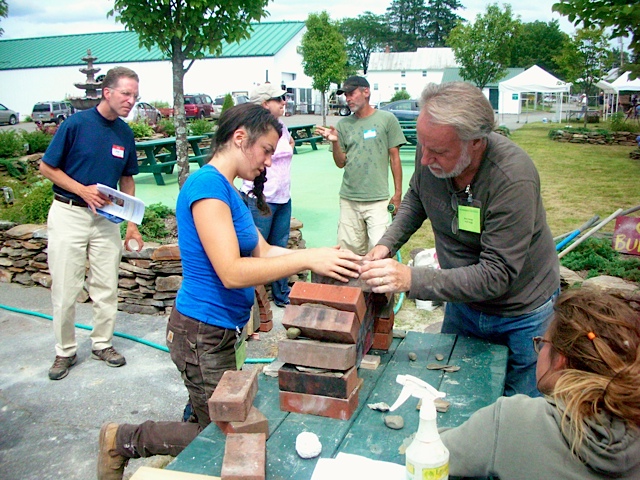
J. Patrick Manley III instructs a small group of wood-fired oven hobbyist on how to build a brick oven during the Kneading Conference held at the Skowhegan Fairgrounds on Thursday.
A small crowd of about 50 people gather around Dawn Woodward and Naomi Duguid as they put on a yeasted crackers workshop during the Kneading Conference held at the Skowhegan Fairgrounds on Thursday.
A small crowd of about 50 people gather around Dawn Woodward and Naomi Duguid as they put on a yeasted crackers workshop during the Kneading Conference held at the Skowhegan Fairgrounds on Thursday. Buy Photo
Alex West, right, of Hartland watches as Stu Silverstein, left, leads a workshop on earth oven building during the Kneading Conference held at the Skowhegan Fairgrounds on Thursday.
Alex West, right, of Hartland watches as Stu Silverstein, left, leads a workshop on earth oven building during the Kneading Conference held at the Skowhegan Fairgrounds on Thursday. Buy Photo
A small group of bread and grain hobbyist gather to hear Sam Hayward speak on the subject &quotLoaves and Fishes: Telling Maine's Story with Food" at a workshop during the Kneading Conference held at the Skowhegan Fairgrounds on Thursday.
A small group of bread and grain hobbyist gather to hear Sam Hayward speak on the subject "Loaves and Fishes: Telling Maine's Story with Food" at a workshop during the Kneading Conference held at the Skowhegan Fairgrounds on Thursday. Buy PhotoSKOWHEGAN, Maine — A burgeoning industry focused on grain production in Somerset County was on display this week in SkowheganThe Maine Grain Alliance hosted its sixth annual Kneading Conference on Thursday and Friday, an event that has received national attention for its focus on local grain production, milling and bread making with flour from locally raised grains.
Roughly 250 people were expected to attend the conference, which includes informational workshops on everything from building wood-fired clay brick ovens to how to mill acorn flour.
One of the lead organizers behind the event is Amber Lambke, executive director of the Maine Grain Alliance and co-owner of the Somerset Grist Mill in Skowhegan, which began milling locally grown grains into flour in September 2012. Lambke and her business partner, Michael Schulz, are already buying grain from a dozen Maine farmers and selling the flour under the Maine grains label to markets throughout New England.
“We’ve been symbolic of the business growth that can happen when we pay attention to grains,” Lambke said.
The Kneading Conference and the Somerset Grist Mill are part of a calculated economic development strategy for the Skowhegan area.
The ball got rolling in 2007. Lambke, who had been volunteering for Main Street Skowhegan, had been reading Charting Maine’s Future, the report published in 2006 by the Brookings Institution that laid out a strategy for Maine’s economic future.
One of the report’s main recommendations was to focus on existing strengths and promote cluster development around those strengths.
In Skowhegan, Lambke and a group of people began to notice trends that pointed to what one of the area’s strengths could be. First, more and more bakers around Maine were struggling to find enough flour made from Maine-grown grain. Second, a local mason who built wood-fired bread ovens found his trade to be in increasing demand from people around the country who wanted to bake their own bread.
“It was kind of a culmination of bakers and a mason and some of us who jumped in as community organizers and volunteers who cared about Skowhegan’s revitalization,” Lambke said. “We came together and decided to launch a conference that brought these different trades together to talk about how we could work together to revive a regional grain economy.”
While farmers in Aroostook County have continually grown grain for hundreds of years, Lambke said grain production had all but ceased in the rest of the state as the availability of inexpensive grain started arriving from the midwest.
At one time, Maine was the breadbasket of New England, she said. In the 1830s, farmers in Somerset County produced 239,000 bushels of wheat a year (a bushel of wheat equals roughly 60 pounds), she said.
In 2007, only one farm in Somerset County produced wheat, according to the 2007 Census of Agriculture, the most recent data available. That farm’s production in bushels was not reported to avoid disclosing proprietary information. (The Census of Agriculture is completed every five years, but the 2012 census data likely won’t be available until 2014.)
There are today at least 22 farms in the Skowhegan area growing wheat, Lambke said, though they’re not all growing it for human consumption.
While more farmers began growing wheat, another piece of the puzzle was still missing: the infrastructure necessary to mill those grains into flour. Lambke said there were at one time 13 mills in the Skowhegan area, with the last one closing in the 1950s.
So, as the Kneading Conference got established and started bringing together various bread bakers, farmers and oven builders, Lambke turned again to the strategies she had read about in Charting Maine’s Future.
“The concept was that a lot of these businesses were interconnected and without one the others can’t succeed, so the cluster concept encourages us to look at where the leaks and where the gaps are,” she said.
The answer was obvious. “The milling infrastructure was simply missing,” Lambke said.
So Lambke, who had no prior experience in milling, baking or even farming (she’s actually a speech pathologist by training), decided she wanted to build the Skowhegan area’s first grist mill in more than half a century.
Lambke and Schulz bought the former Somerset County Jail in 2009 for $65,000. They spent several years raising money through investors associated with Slow Money Maine and with a Kickstarter campaign. The pair officially launched milling operations in September, and expect to buy grain from a dozen farmers in Maine this year.
The mill is now churning out stone-ground flour and oats from Maine-grown grains and selling it under the Maine Grains brand to markets in Maine, Massachusetts, Vermont, Boston and New York City. It will soon be supplying grain to Whole Foods’ production bakery in Boston.
Lambke said she saw the mill “as a real opportunity. If the infrastructure were here, we could encourage more grain production on farms.”
One of those farmers she hoped to encourage is Adam Nordell, who moved to the area three years ago with his partner, Johanna Davis, to take advantage of farming land along the Sandy River, which he called “some of the best soil in the state.”
Nordell and Davis run Songbird Farm in nearby Starks.
Songbird Farm along with a few partners is launching a community-supported agriculture program focused on grains and dry goods. It works like other, more common CSA programs, in which a person at the beginning of the season buys a share of a farmer’s future harvest, but instead of receiving a weekly batch of veggies, members of Songbird Farms’ CSA receive fresh-ground wheat flour, buckwheat, oats and heirloom dried beans.
“I don’t know if we could be doing what we’re doing in other parts of the state,” Nordell said. “It’s phenomenally exciting — the buzz that’s building and the knowledge around grains that’s building here in Skowhegan.”
Four years ago, witnessing this rising interest in locally grown grains, it became clear to Ellen Mallory, a sustainable agriculture specialist at the University of Maine Cooperative Extension, that there was a need for more research on what it takes to grow grain in Maine and to produce educational resources for farmers interested in doing so.
As the milling infrastructure disappeared when farmers stopped growing grain, so did much of the knowledge necessary to grow those grains. To reclaim that knowledge, Mallory, along with partners in Vermont, in 2009 created the Northern New England Local Bread Wheat Project with a $1.3 million grant from the U.S. Department of Agriculture.
She’s now a board member of the Maine Grain Alliance and helps farmers such as Nordell grow grain.
“Skowhegan is starting to become more of an example of how to foster economic development based on agricultural-based industry,” Mallory said. “I think for Maine that holds a lot of potential.”
The conference has spun off several local businesses, according to Lambke.
Joel Alex has plans to open a small-scale malt house in Skowhegan that would produce malt barley for the craft brewing and distilling industry. He considered locating in Aroostook County, but was drawn to Skowhegan because of the Somerset Grist Mill and the general energy in the area around grain production.
“I think Skowhegan has this energy about it,” Alex said. “It’s this up-and-coming food center, and Amber [Lambke] has been great about making that about grain. I think among people who are familiar with food systems in Maine we’re starting to hear a buzz growing around Skowhegan as a food hub, and in particular grains.”
When Jim Amaral launched Borealis Breads in 1993, the ability to buy flour made from Maine-grown grains was near impossible.
“Finding a couple hundred pounds was an issue,” he said.
But he persevered, and began talking to farmers around Maine in an effort to drum up interest in growing grain for food production, which is higher quality than the grain farmers will grow as animal feed. He hooked up with Matt Williams, a farmer in the Aroostook County town of Linneus, who began in 1997 growing grain for Borealis Breads. In 2002, Williams began his own milling operation, which is now called Aurora Mills and Farm.
After years of struggle, Amaral can now look back and say he played a big part in kickstarting the rebirth of Maine’s grain industry.
This year, he’ll use roughly 60,000 pounds of Maine flour to bake his bread. In fact, this week he put in his first order to Maine Grains for two pallets of wheat flour from the Somerset Grist Mill.
The buzz around local food and local grains in Skowhegan creates a “social glue,” Amaral said. “Food brings people together in a lot of different ways.”
Amaral believes the benefits of the Kneading Conference in particular, which provides plenty of informational workshops and inspiration, will continue to bear fruit long into the future.
“It’s easy to underestimate the impact an event like this has on the community, but it is pretty remarkable” he said. “It’s like throwing a stone into a pond. The ripple effect over a month, six months, a year, five years, 10 years, I think will be pretty remarkable. The next Stonewall Kitchens of Maine may come out of a workshop here.”
While the conference will be over by Saturday, the Maine Grain Alliance will host an artisan bread fair at the Skowhegan State Fairgrounds from 9 a.m. to 3 p.m., which is free (though bring $2 for parking) and open to the public.
Lambke expects as many as 3,000 people to attend the artisan bread fair this year.

Friday, July 26, 2013

Kneading Conference 2013

Another great Kneading Conference in Skowhegan, Maine.
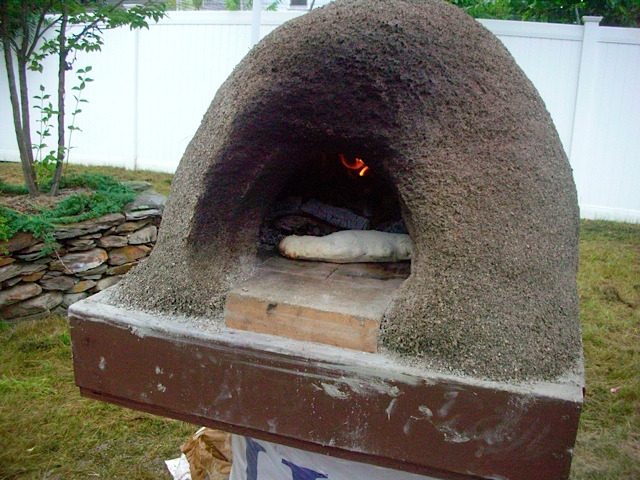
Images from the earth oven building workshop