Sunday, June 5, 2011

Yesterday's Workshop

June 4, 2011

Under clear blue skies, no humidity and a temperature of 72º F., no one could complain. Besides, we constructed three mud ovens that participants took home and one demonstration brick oven that was an instant hit. In fact, two of the participants returned today to gaze in wonder at the simple brick oven that they had constructed yesterday. And who would blame them.
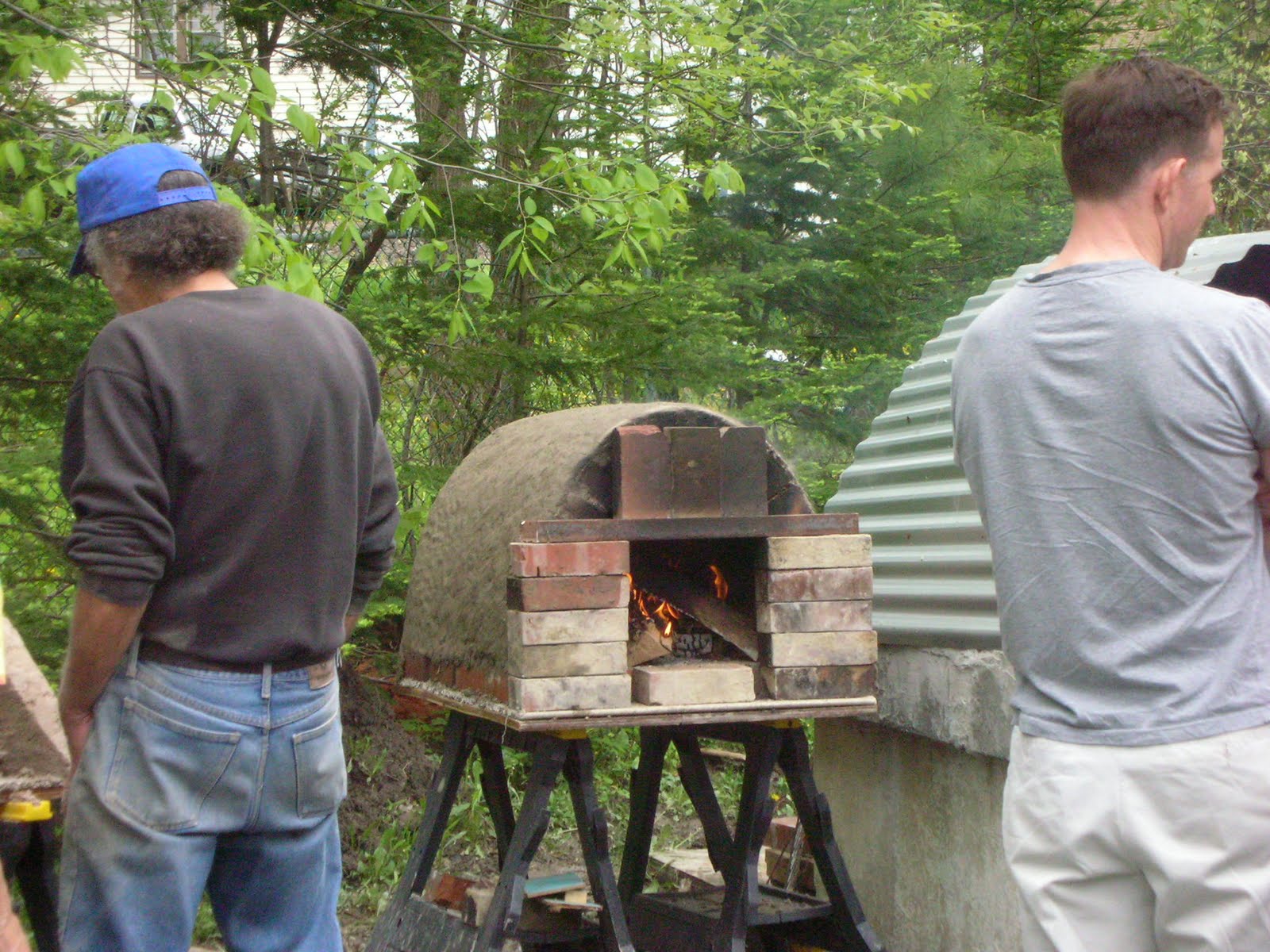
The oven took three fledgling oven builders about two hours to construct.
The cost of the materials was about $68.00
 Low-cost, easy-to-build brick oven
Immediately after building the oven, it was fired up, and within one hour we were making pizza. The floor temperature easily reached the desired temperature of 700ºF.
               At work

  Brick oven in back
(folks were still mixing mud, and the brick oven was already done and fired up)

Not only did this oven go up faster than the little mud ovens, but this was supposed to be a mud oven workshop. Sure, folks enjoyed the mud ovens, but really, I think most decided that they'd like to have the low-cost brick oven in their back yards.


  Yesterday's oven builders


But will they ever be able to get it out of the car?


Sunday, May 29, 2011

The Corbel Arch

Having just finished a workshop where the participants completed two mud ovens and one brick oven, we then needed to constrict the opening of the brick oven so it would better retain heat. We first piled up a few bricks and with two short lengths of angle iron, we were easily able to make the opening smaller.
Without angle iron, a corbel arch is also a simple way to accomplish the same task. This type of arch is found in many parts of the world, but it is particularly prominent in Maya architecture.
The aesthetics of your oven design can be a reflection of your own unique ideas. These simple low-cost ovens really lend themselves to your creative spirit. If you make a mistake, well, no big deal because you can try something else. 

Friday, May 20, 2011

San Francisco Sourdough

Aside from the fact that the wild yeasts and bacteria that populate the city of San Francisco can be found elsewhere, I really think that the sourdough breads from San Francisco do have a distinctive taste. The breads I make far from San Francisco really don't taste very much like the breads from the bay area even though the starter I use may be similar.
A curious thing about starter (at least mine) is that it seems to know if I'm away on a trip (just like a pet), and I am punished for not giving it the close attention it is used to. Upon returning home, I find my starter balky and resists getting motivated again.
I know it's crazy, but do the yeast and bacteria have some type of awareness that we fail to comprehend.
Bakers prepare sourdough bread at the Boudin Bakery at Fisherman's Wharf in San Francisco

Thursday, May 19, 2011

Bjorn Zipprich's dual chamber oven

Bjorn has constructed a very interesting earth oven that has two chambers, and because of the chambers, air pollution is significantly reduced. This is explained in the video.


 Bjorn's dual chamber oven merges with the austere New Mexico landscape

Wednesday, May 11, 2011

The Tandoor

The tandoor is a vertical type oven that is ubiquitous in many parts of the world, particularly India and the Middle East. It is primarily used for making flat breads.  In the New York Times today there's a story about an American who is manufacturing tandoors in the United States. For me, I'll stay with my traditional front loading mud oven.

Tuesday, May 10, 2011

Sally's Apizza

The best pizza I ever had came from Sally's Apizza in New Haven, Connecticut. This is not wood-fired pizza, but rather, it's coal-fired.
Pizza "experts" always say to use high gluten flour for the pizza crust, but when I saw someone from Sally's interviewed, it became clear that they use a lower gluten flour because they said they could never "toss" their pizza dough because the dough would fall apart. They claimed that bakers who "toss" the dough, only do it as a publicity stunt, and you need a high gluten flour to "toss" or "spin" the dough.
What kind of flour do you use for pizza crusts?


Wednesday, May 4, 2011

Earth Oven Classes

 Though the office of Adult Ed. in Waterville, Maine, I'll be teaching some oven building classes. If you find that the classes are full this spring, perhaps you can take the class in the fall. Also, I'll be leading a workshop at the Kneading Conference this summer.


Oven workshop in Showhegan, Maine

Build a Wood-Fired Pizza/Bread Oven


If you've ever wanted to have a pizza oven in your backyard, then join us and learn how to build various types of woodfired pizza/bread ovens. No experience required. Participants will work with clay and brick and construct low-cost ovens that will make the very best pizzas and breads. We will also be assembling a portable brick oven that would be ideal for setting up at special events. Discussions include techniques for making pizzas, fl at breads, sour dough and no-knead breads. Unique sourdough starter shared with all in class. Everyone will get to bake in the instructor's oven and contribute to the pizza party at the end of class. One or two participants can take a mini earth oven home for an additional $35 fee, payable to the instructor.
$39.00
Online price

Course location Course location

Location address not available.
Please contact us for the exact location of where this course will be held.

Phone: 873-5754-Waterville/Winslow ~ 465-9134-Messalonskee

Course schedule Course schedule

This course meets Sat from 9:00 am to 4:00 pm for 1 week.
Start date: May 21st, 2011
End date: May 21st, 2011
Also Sat, June 4th, 2011
 Father Paul with his shrink wrapped oven ready to travel.

Thursday, April 14, 2011

Oven Opening


Many years ago I became fascinated with earth oven construction after reading a book called, “The Bread Ovens of Quebec” by Boily and Blanchette. This is not an easy book to find, but if you come upon it, then buy the book. Just recently, however, the book became available for a free download on the web. Not only is it filled with interesting folklore, but also there’s real information on clay oven construction. The authors found that the most successful ovens had door-opening dimensions that related to interior oven height. Kiko Denzer and others have used this formula and I saw no need to reinvent something that has been working for a very long time. Therefore, I use it too, but with some wiggle room. Opening height should be 63% of the height of your sand mold. If your mold is 14" tall, then the height of the opening should be 8.82".
0.63 x 14 = 8.82   Generally, the opening width is half the diameter of the floor. If your floor diameter is 22 1/2 inches. Half of this is 11 1/4 inches.
I am emphasizing the word "generally" because they may be problems with this rigid formula. I believe that the French Canadians were much more interested in baking bread than they were interested in making pizza, and with such a narrow opening it might prove difficult to fit a peel inside or maneuver  a pizza around. 
I have spoken to some people whose one regret concerning their ovens is an opening that's too narrow. 
So, if you're making pizzas, then be sure to make the opening wide enough to accommodate them. Yes, you'll lose more heat with a larger oven opening, but that's better than having an opening so small that your oven won't work properly for you.

Wide enough for pizzas


Tuesday, April 12, 2011

Back To Basics

A couple of posts back, I talked about dumping the risen dough directly on the peel and then straight into the oven. I skipped the step where the risen dough is eased out onto your counter, worked a little by folding and then placed in bannetons (baskets) to rise again before baking.
Initially I was pleased because the breads sure looked fine.

However, I wasn't exactly pleased with the crumb (sorry I don't have a photo).
The crumb had rather small mouse holes, and I attribute this to the fact that the gluten in the loaf was not fully developed. Yesterday I made sourdough bread, without any shortcuts, and the loaves were truly superior, having larger, more irregular mouse holes and being more elastic. Having spent time folding and working the dough by stretching it was well worth the extra effort.

Thursday, April 7, 2011

Let's Knead the Dough

What! After all this talk about no-knead bread, you're now suggesting we start kneading dough again? Well maybe. Check out this video that I find quite seductive. Of course, the setting really helps with a spectacular view of the ocean. Watch the way the accomplished baker handles the dough to strengthen the gluten fibers. His wood-fired oven is truly a humble one, probably not insulated and without a "real" door, and yet, in spite of it's limitations, it bakes bread. We can avoid so many complications if we could just keep it simple.