The 2010 Kneading Conference is over, and it certainly was a wonderful experience for me, and I'm sure, for a lot of other people as well. In the earth oven workshop that I led, we constructed three earth ovens on Thursday, and we were baking flat breads and pizzas on the same day. Actually, we didn't have the pizza ingredients until Friday, so on Friday we made the pizzas, but on Thursday we made pitas.
Hi energy
Shrink wrapped
Father Paul with his shrink wrapped oven. Ready to travel.
Thanks to Ellen Paul, Mary Dunn and many others, we officially opened the Moor Street Community Garden in Waterville, Maine with brick oven pizza for all. The oven shown was put together with 100 red bricks and some angle iron. It took 30 minutes to assemble.
Note the three arroyos etched right into the dome. This was caused by rain running off the corrugated roofing. The lesson, of course, is to thoroughly protect your earth oven from the elements.
Hi
I'll be leading a workshop on earth oven construction at the Kneading Conference in Skowhegan, Maine. July 29-30. Come join us, and check out the website.
http://www.kneadingconference.com/
Today I made a dry stacked, portable brick oven that can be quickly assembled. It sits on simple saw horses, and it's constructed with 92 red bricks. The oven will be used at the grand opening of the Moor St. community garden in Waterville, Maine on Sunday, July 18 and on subsequent events. Free pizza, drinks and deserts. Everyone is welcome. Come at noon.
While recently in France I noticed this neat oven insert that will really crisp the bottom of your pizza, fast. Such a simple device, I wish I had thought of it myself.
You simply place the insert over a pile of fiery coals and place your pizza on top. Next time, I'll try to get a photo of the pizza resting on top.
Doing a simple "snake test" should be enough to determine if you're actually working with clay because that's what you need to build an earth oven. But that's just the beginning. You then need to mix sand with clay. Generally the proportion is two or three parts sand to one part clay. There are some who have built ovens using clay exclusively, but it hasn't worked for me. I have found that if you use too much clay, then your oven might develop some pretty severe cracks. If you use too much sand, then your oven could fall apart (had it happen).
What you want is for your clay/sand mixture to fuse together and then it is applied around and over your sand form in a consistency that's neither too wet nor too dry. If it's too wet, let you'll get lots of unacceptable slumping. If it's too dry, then it won't hold together.
You can look at all the videos, read all the books, search the internet, but nothing will work better then to have some help from someone who has had some experience building earth ovens.
When insulating the domes of earth ovens, I have used a mixture of 6 parts perlite to 1 part clay slip, and I have also used a mixture of 6 parts perlite to 1 part Portland cement. The less clay or cement you use the better, because they both reduce the insulation value of the perlite, but unless you take extraordinary measures, you need some sort of binder to hold the perlite in place.
Only the perlite with cement holds its shape when wet
An important thing to consider is moisture. Perlite bound with cement holds together when wet, but perlite bound with clay slip does not.
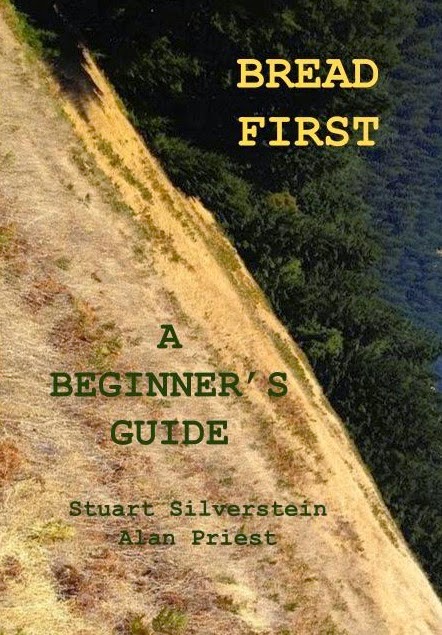
Bread First is a book for beginners. Everything a beginner needs to know can be found here. You can expect to bake great bread the first time. The process is simple, and the ingredients are readily available. "No knead" baking is for everyone. No experience is required. Clear instructions with photos make everything extra easy.
Bread Earth And Fire: Earth Ovens And Artisan Breads
For the past couple of years I've been revising my book, Bread Earth And Fire. I've added the subtitle Earth Ovens And Artisan Breads because I feel this more fully explains what the book is about. Along with the photos, you'll now find drawings that better illustrate the oven building process, new ovens to build as well a history of bread from the "beginning of time."
Bread Earth And Fire: Earth Ovens And Artisan Breads is available as an ebook or print copy from Lulu.
Amazon's Createspace carries a print copy of the book.
Stu's Art Gallery
Dead River Rough Cut (the movie)
Walt feeds gorby bird. Most requested movie at the Maine State Prison
Dead River Rough Cut
For information about Stu Silverstein's and Richard Searls' backwoods movie, go to: www.deadriverroughcut.com.
I write about bread and wood-fired bread ovens. Sourdough bread baking is my specialty. While the dough is rising I have time to make art, lots of art. Each winter I travel to Guatemala to build energy efficient stoves for the Mayas.